What “not heating” actually tells a technician
A furnace that will not heat can fail at one of three stages: it never receives a call for heat, it receives the call but never establishes a flame, or it establishes a flame that is shut down before the air gets warm. Each stage points to a different group of parts, which is why the first useful question is not “what is broken?” but “how far does the sequence get?”
If the blower runs continuously and the air is room temperature, the burners are likely never firing or are being shut down almost immediately. If nothing at all happens — no blower, no hum, no display — the problem is usually upstream: power, the thermostat, a door switch or the control board. Paying attention to what the furnace does in the first two minutes after you raise the thermostat gives a technician a real head start.
Common causes of a furnace that will not heat
- Thermostat set incorrectly, set to fan-only, or losing power from dead batteries
- A severely clogged filter restricting airflow until the limit switch shuts the burners down
- A dirty or failing flame sensor that cannot confirm a flame, causing lockout
- A cracked or worn hot surface igniter that never lights the burners
- A blocked intake or exhaust that keeps the pressure switch from closing
- A failing inducer motor that cannot establish draft
- Gas supply interruption or a closed manual gas shutoff after other work in the home
- Control board faults, tripped breakers, or a door panel that is not seated on its safety switch
Safe checks you can make first
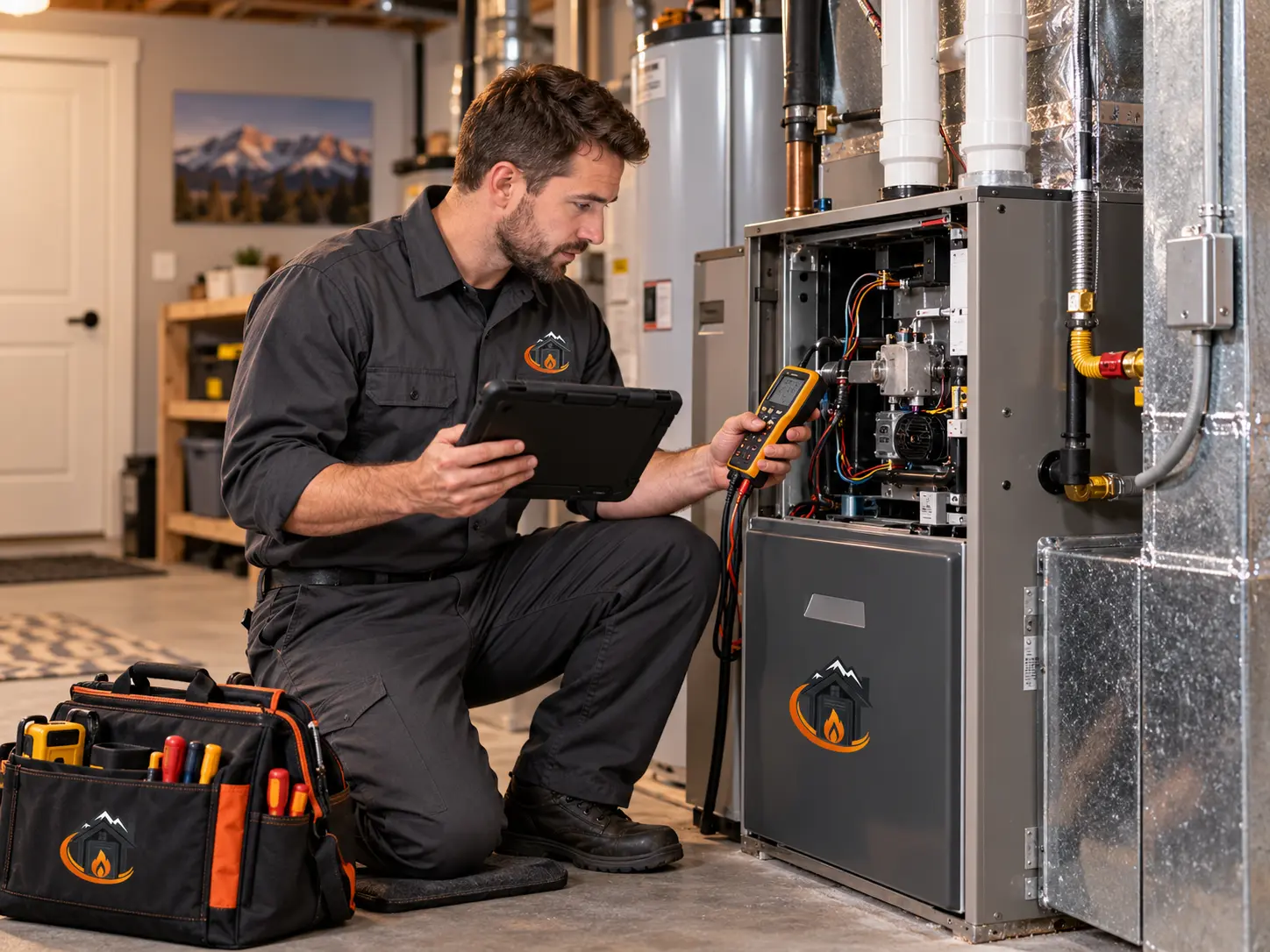
If none of those restore heat, the next step is diagnosis rather than parts-swapping. Reading the furnace's blink or error code, measuring flame signal, checking gas pressure and verifying draft all require tools and training.
- Confirm the thermostat is set to HEAT and the target temperature is at least a few degrees above the current room reading.
- Replace thermostat batteries if the display is dim, blank or flashing a low-battery indicator.
- Check the switch on or near the furnace that looks like an ordinary light switch — it is the furnace service switch and is easy to flip by accident.
- Check the breaker panel for a tripped furnace breaker. Reset it once; if it trips again, stop and call for service.
- Pull the accessible filter and hold it up to a light. If you cannot see light through it, replace it with the same size and orientation.
- Walk the home and open any supply registers that have been closed, and clear furniture or rugs blocking return grilles.
- Make sure the furnace door or access panel is fully seated — most furnaces will not run with the panel off.
Talk through your furnace problem
For service availability, please have your 5-digit ZIP code ready.
Call now for a FREE QUOTE and for service availability. Please have your 5-digit ZIP code ready.
What not to touch
Do not bypass, jumper or tape down any safety control. Pressure switches, limit switches, rollout switches and door switches exist to stop the furnace before a dangerous condition develops, and defeating one converts a nuisance fault into a genuine hazard. Do not adjust the gas valve, remove burners, clean inside the heat exchanger or perform live-voltage testing.
Related symptoms worth comparing
If the air coming from the vents is noticeably cool rather than simply lukewarm, read furnace blowing cold air. If the furnace starts and stops in short bursts, that pattern is covered in furnace short cycling. If there is no response at all when you raise the thermostat, start with furnace won't turn on.
Repair or replace when a furnace stops heating
A no-heat call on a furnace under roughly fifteen years old with a clean service history is usually a straightforward repair — igniters, flame sensors, pressure switches and capacitors are ordinary wear items. The calculation changes when the furnace is older, has needed several repairs in recent seasons, or when the failed component is a heat exchanger or the system is no longer well matched to the house.
Rather than applying a rule of thumb, weigh the current repair against the age, the likely remaining service life and what a replacement would deliver in comfort and efficiency. Our repair vs. replacement guide and the furnace repair cost calculator are built to help you think it through before anyone quotes you a number.
Furnace Safety Comes First
If you smell gas, see smoke or fire, or suspect carbon monoxide, stop troubleshooting. Move everyone out of the affected area, then contact your gas utility or emergency services from a safe location.
Never bypass a pressure switch, limit switch, rollout switch, door switch or flame sensor, and never attempt gas valve, burner, heat exchanger or live-voltage work. Those controls exist to shut the furnace down before a dangerous condition develops.
Read our carbon monoxide safety guide