Is it really the thermostat?
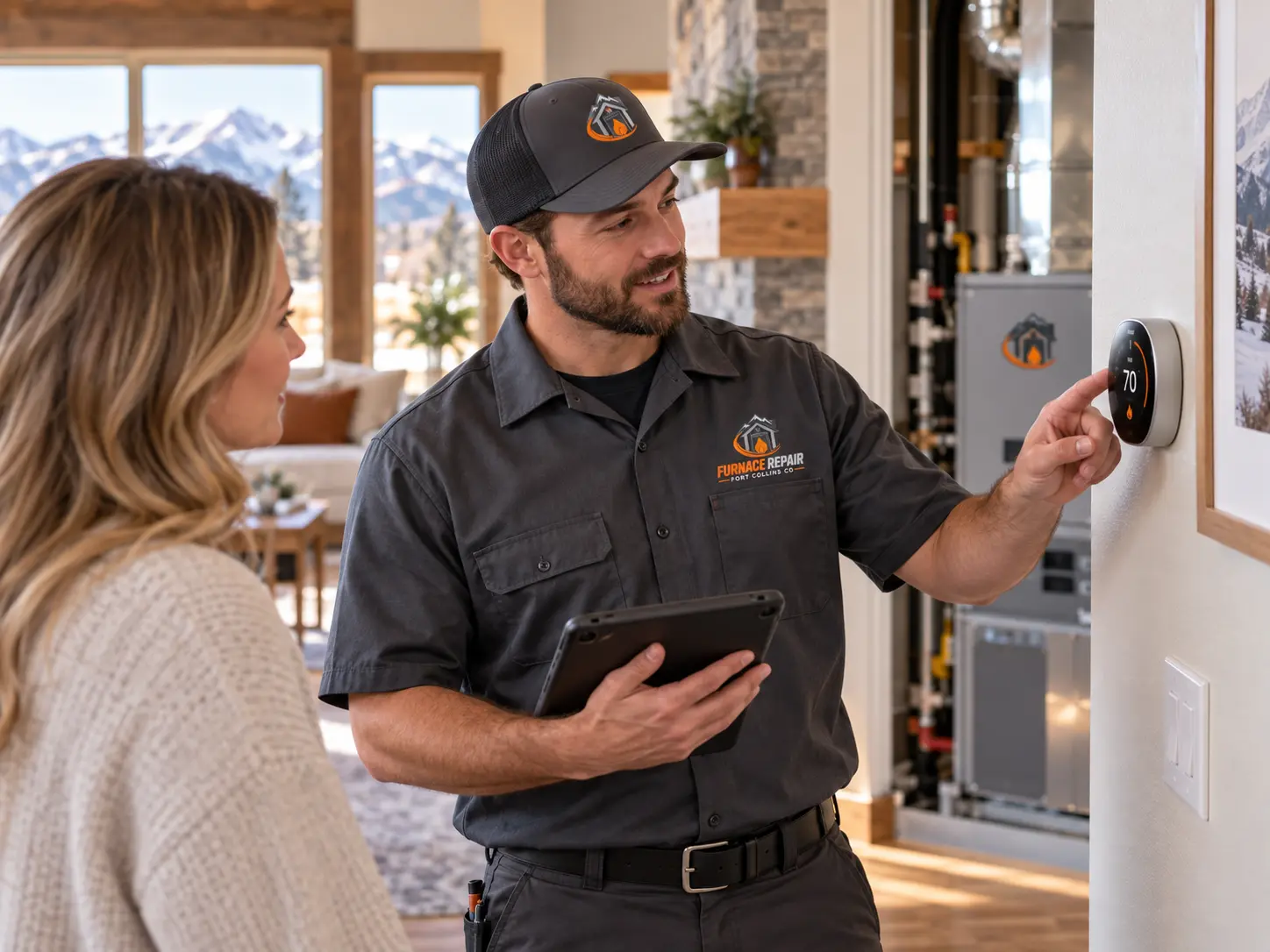
A thermostat's only job is to close a circuit when the room needs heat. Everything else — display quality, scheduling, app connectivity — is convenience layered on top. So the diagnostic question is simple: is the heat call reaching the furnace?
A technician answers that in seconds by jumpering the appropriate terminals at the furnace under controlled conditions. If the furnace fires, the thermostat or its wiring is the problem. If it does not, the thermostat is innocent and the fault lies in the furnace itself.
Common thermostat-side problems
- Dead or weak batteries — still the number one cause of an unresponsive thermostat
- Set to COOL or OFF, or the schedule is overriding the temperature you set
- Fan set to ON, producing the cold air complaint described elsewhere on this site
- Loose or corroded wire at the terminal block behind the thermostat base
- Missing common wire on a smart thermostat, causing intermittent dropouts
- Incorrect system-type configuration after a DIY installation
- Poor placement — direct sun, near a supply register, on an exterior wall, or in a hallway that does not represent the living space
- Internal sensor drift, where the displayed temperature no longer matches reality
Safe checks you can make
- Replace the batteries even if the display looks normal.
- Set mode to HEAT, fan to AUTO, and raise the setpoint five degrees.
- Hold a separate thermometer near the thermostat for fifteen minutes and compare readings.
- Check that a hold or vacation schedule is not overriding your setting.
- Gently remove the faceplate and confirm no wire has backed out of its terminal. Do not rewire.
Talk through your furnace problem
For service availability, please have your 5-digit ZIP code ready.
Call now for a FREE QUOTE and for service availability. Please have your 5-digit ZIP code ready.
Smart thermostats and older furnaces
Smart thermostats are excellent when installed correctly, but they need reliable 24-volt power. On older Fort Collins homes with four-wire thermostat cable and no common conductor, power-stealing can cause intermittent heat calls, random restarts and false low-battery behavior. Running a proper common wire or installing an approved adapter resolves it permanently.
Compatibility also matters for two-stage and variable-speed equipment. A thermostat configured for single-stage operation on a two-stage furnace will never use the second stage, which shows up as long run times in cold weather.
Placement fixes comfort complaints
If one part of the house is always too warm and another always too cold, relocating the thermostat or adding remote sensing often helps more than any equipment change. Combine that with the airflow corrections covered in weak furnace airflow for the best result.
When the thermostat is fine
If the heat call is reaching the furnace and nothing happens, move on to furnace won't turn on or furnace not heating. Thermostat replacement is inexpensive, but replacing one to chase a furnace fault simply delays the real repair.
Furnace Safety Comes First
If you smell gas, see smoke or fire, or suspect carbon monoxide, stop troubleshooting. Move everyone out of the affected area, then contact your gas utility or emergency services from a safe location.
Never bypass a pressure switch, limit switch, rollout switch, door switch or flame sensor, and never attempt gas valve, burner, heat exchanger or live-voltage work. Those controls exist to shut the furnace down before a dangerous condition develops.
Read our carbon monoxide safety guide