
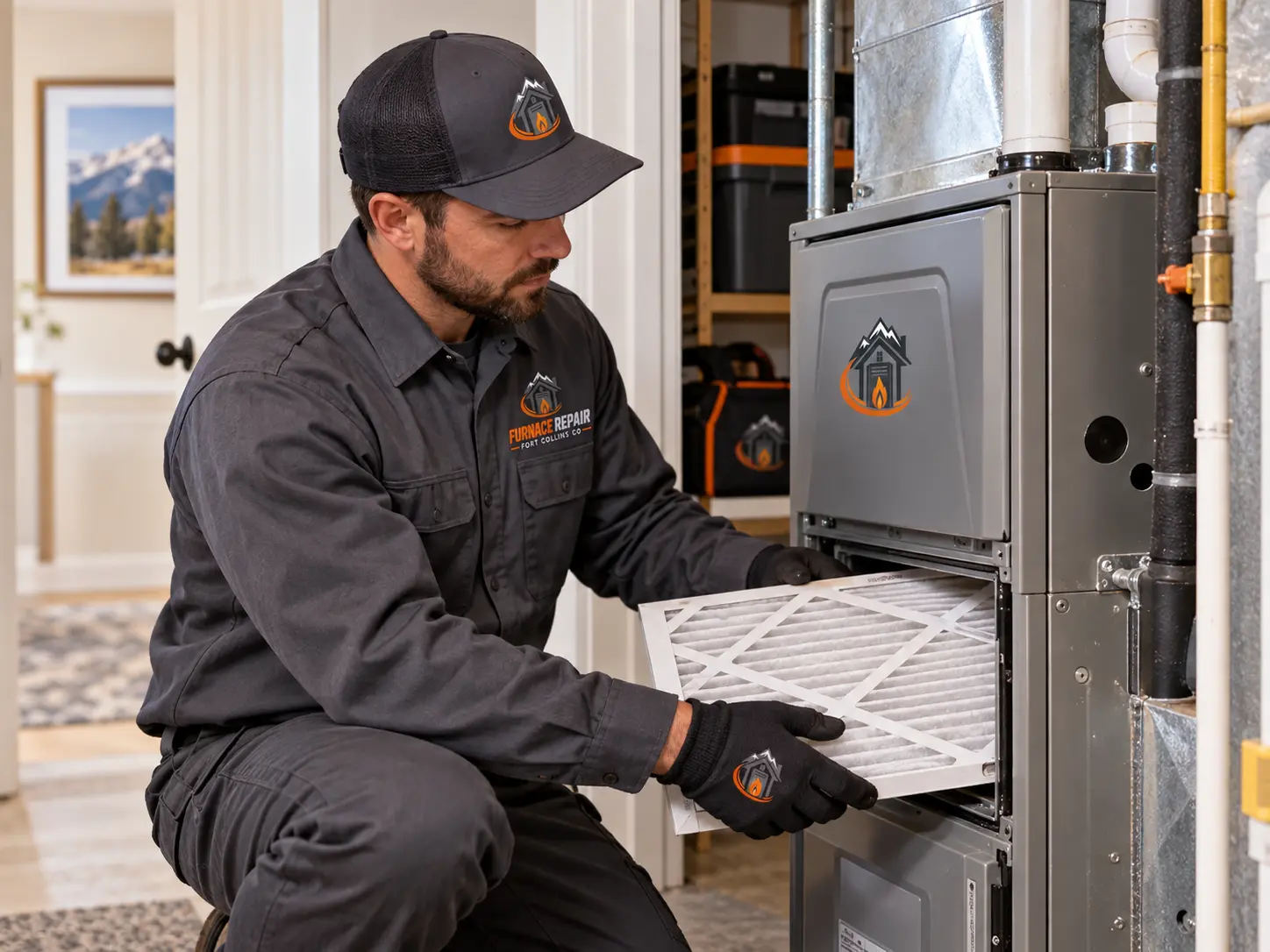
Furnace maintenance and duct cleaning are different things
Furnace maintenance is service performed on the appliance: inspecting combustion and venting, checking the flame signal, measuring temperature rise, verifying safety controls, checking the blower and looking at static pressure. It is diagnostic work with measurements attached.
Duct cleaning is a cleaning service performed on the distribution system — the ducts, registers and sometimes the blower compartment. It can genuinely improve a specific situation, but it does not inspect or verify the furnace, and it does not correct duct design problems.
The two answer different questions. If a furnace is not performing well, maintenance and an airflow evaluation tell you why. See furnace maintenance for what annual service actually covers.
What furnace airflow actually depends on
Air has to make a complete loop: return grilles to filter to blower to heat exchanger to supply plenum to branch ducts to registers and back again. Anything that narrows that loop reduces airflow, and the furnace feels it as increased resistance.
- Filter condition and filter type — the most common restriction and the easiest to fix
- Total return capacity — many homes have less return than the equipment wants, particularly after remodels
- Blower condition and speed setting — a struggling or mis-configured blower cannot make up for restriction
- Duct sizing, length and the number of sharp turns
- Crushed, disconnected or badly sagging flexible duct
- Closed, blocked or furniture-covered registers
- Leakage in unconditioned spaces, which delivers heated air where nobody lives
Filter restrictions
A loaded filter, or a filter far more restrictive than the system was designed for, reduces airflow across the heat exchanger. That shows up as weak air at the registers, longer run times and sometimes limit-switch shutdowns. It is where any airflow conversation should start — our furnace filter guide covers sizing and replacement intervals.
Return airflow
The supply side can only deliver what the return side brings in. Undersized returns, a single central return in a multi-level home, or return paths blocked by closed doors all limit the system regardless of how clean the supply ducts are.
Blocked supply vents
Closing registers in unused rooms feels efficient and usually is not. It raises pressure in the duct system, increases leakage and can push the furnace toward limit shutdowns. Leaving registers open is generally the better default.
Damaged or poorly configured ductwork
Flex duct pinched behind storage, a branch disconnected in a crawl space, a run that takes four sharp turns to reach a back bedroom — these cause real, persistent comfort problems. Cleaning does not fix any of them, which is exactly why an evaluation matters more than a cleaning.
Where dust actually comes from
Most household dust is generated inside the home continuously: fabric fibers, skin cells, pet dander, outdoor particles tracked or drawn in, and cooking residue. Some settles in ductwork, most settles on surfaces. Seeing dust in the house is normal and is not by itself evidence that the ducts are causing a furnace problem.
Renovation and construction debris
This is a legitimate case for cleaning. Drywall dust and sawdust in a duct system after a remodel are a different category from ordinary household dust, particularly if registers were left uncovered during the work.
Pet hair and household debris
Homes with shedding pets load filters much faster and can accumulate material at return grilles. More frequent filter changes usually address this more effectively than periodic duct cleaning.
Why visible dust does not automatically mean the ducts are the problem
A dusty register face is the air passing by it, not necessarily a dirty duct interior. Meanwhile, a genuinely restricted filter or an undersized return will hurt furnace performance even in a spotless duct system. Judging the system by what you can see at the grille is the most common way homeowners misdiagnose airflow.
Furnace problem vs. possible duct or airflow issue
The same symptom can come from the appliance or from the distribution system. This table shows how a single complaint splits into different lines of investigation. It is a framework for asking better questions, not a remote diagnosis of your system.
| What you notice | Could be the furnace | Could be duct or airflow |
|---|---|---|
| Weak airflow | Blower motor, capacitor or blower speed configuration | Restrictive or loaded filter, undersized return, crushed or disconnected duct |
| Uneven temperatures | Blower not delivering rated airflow | Duct layout, long or pinched branch runs, no balancing, poor return paths upstairs |
| High heating bills | Efficiency of the equipment, short cycling, combustion issues | Duct leakage into unconditioned space, restriction forcing longer run times |
| Excess dust | Rarely the furnace itself | Bypassed or ill-fitting filter, return leaks pulling air from a crawl space or attic |
| Whistling noises | Blower speed too high for the system | High static pressure, undersized returns, a nearly closed register or a narrow duct |
| Long run cycles | Capacity, controls or a combustion problem | Restriction reducing heat delivery, leakage losing it before it arrives |
Talk through your furnace problem
For service availability, please have your 5-digit ZIP code ready.
Call now for a FREE QUOTE and for service availability. Please have your 5-digit ZIP code ready.
Signs of furnace airflow problems
Several of these overlap with symptoms covered in weak furnace airflow and furnace keeps running. A struggling blower motor can produce the same complaints, which is why measurement beats assumption.
- Supply air feels warm at the furnace but weak at distant registers
- One or two rooms never keep up with the rest of the house
- The filter loads visibly faster than it used to
- The furnace heats, shuts off early, then restarts a few minutes later while the blower keeps running
- Whistling or rushing sounds at the return grille
- Registers feel hot but the volume of air is clearly low
When an airflow evaluation is more useful than a cleaning
If the complaint is about performance — weak delivery, uneven rooms, short heating cycles, rising bills — an airflow evaluation answers the question directly. Measuring static pressure, temperature rise and delivered airflow shows whether the system is restricted, where the restriction lives, and whether the blower is doing its job.
That measurement can also tell you whether cleaning would help. If the ducts are genuinely fouled, it will show. If the real problem is a filter two sizes too restrictive or a return that was never enlarged after a basement finish, cleaning would have cost money and changed nothing.
Duct cleaning is reasonable after construction or remodeling, after rodent or water intrusion, or when there is visible heavy accumulation. As a routine performance fix for a furnace that is not keeping up, it is usually not where the answer lives. Our furnace efficiency guide covers the factors that do move the needle.
A note on remote diagnosis
Nothing on this page can tell you what is happening in your specific home. Duct systems vary enormously house to house, and two homes with identical symptoms can have entirely different causes. What this page can do is help you ask for the right thing: a look at airflow and the furnace, with measurements, before anyone recommends a service.