A furnace is a sequence, not a switch
It is tempting to picture a furnace as something that simply turns on. In reality a modern residential furnace runs a carefully ordered start-up in which each step has to prove itself before the control board allows the next one. Safety controls sit between the steps, and any one of them can stop the whole thing.
That is good news when something goes wrong. Because the order never changes, the point where the furnace stops tells you a great deal about which part is involved. If you can describe what you hear and how far the furnace gets before it gives up, you have already done half of the useful observation work.
The heating cycle, step by step
That whole sequence takes a couple of minutes from start to steady heat, and the furnace repeats it as many times as the weather demands.
- The thermostat calls for heat. Room temperature falls below the setpoint and the thermostat closes a low-voltage circuit to the furnace.
- The control board responds. The board is the furnace's brain. It receives the call, checks that its safety inputs are in a normal state and begins the start-up sequence.
- The inducer motor starts. This small fan pulls combustion gases through the heat exchanger and out the vent, creating the draft that makes safe combustion possible. It usually runs for a short pre-purge before ignition.
- The pressure switch verifies venting. Draft from the inducer produces a pressure difference the switch can sense. If it closes, the furnace has proof that venting is working. If it does not close, ignition never happens — by design.
- The ignition sequence begins. On most modern furnaces a hot surface igniter glows bright orange; some use an intermittent spark. Older furnaces use a standing pilot.
- The gas valve opens and the burners light. Gas flows to the burner assembly and the flame carries across the burners.
- The flame sensor confirms flame. A small metal rod in the flame passes a tiny electrical current to ground. If the board does not see that current within a few seconds, it shuts the gas off immediately.
- The heat exchanger warms. Combustion happens inside the sealed heat exchanger, which separates flue gases from the air you breathe while transferring heat through its metal walls.
- The blower starts. After a short delay that lets the exchanger warm up, the blower begins moving household air. The delay is why your vents feel cool for the first thirty to ninety seconds.
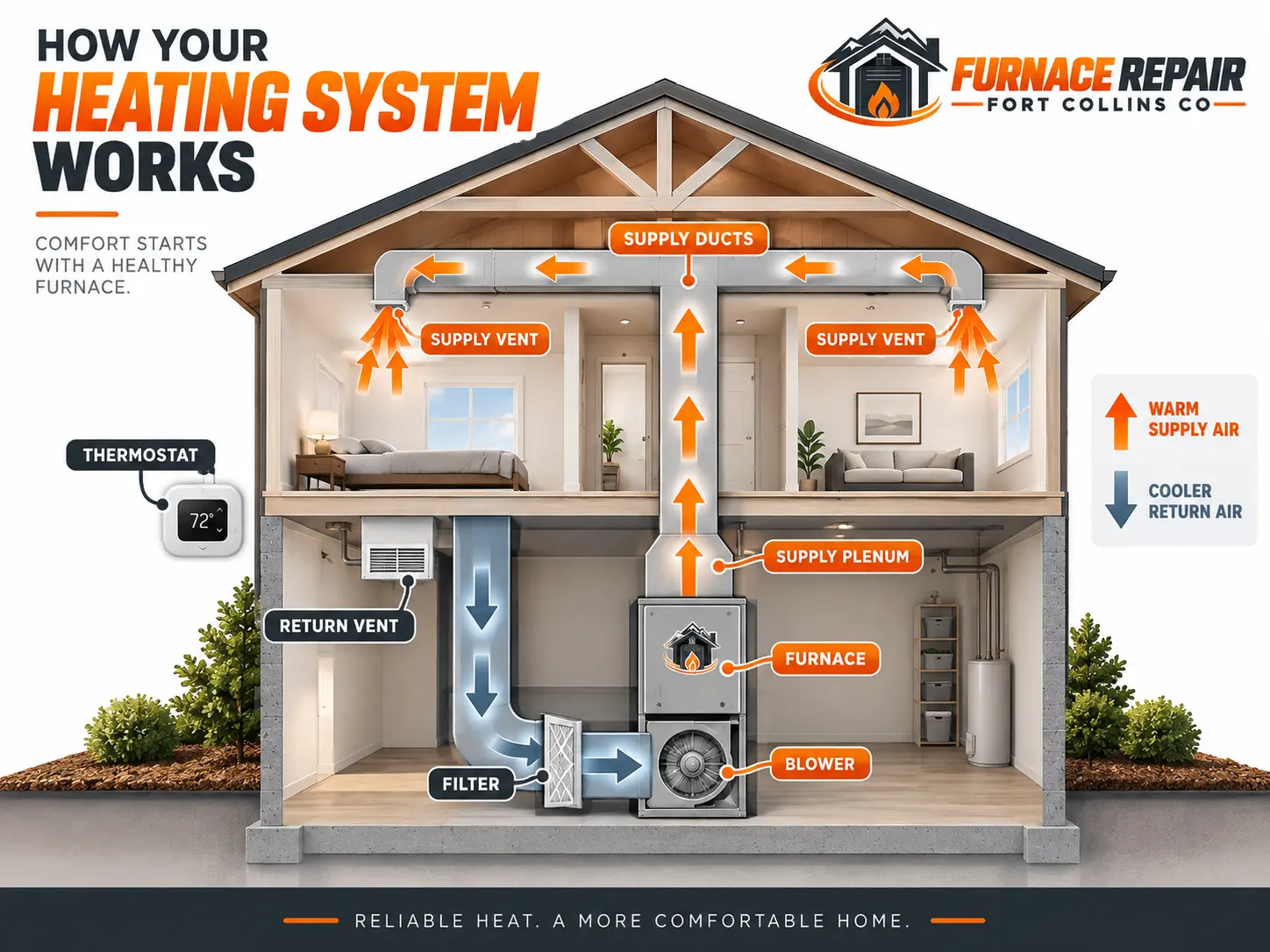
- Return air enters the system. Return grilles pull room air back toward the furnace — the supply side can only deliver what the return side brings in.
- The filter captures particles. Return air passes through the filter before it reaches the blower and heat exchanger, protecting the equipment as well as the air.
- Warm air moves into the supply plenum. Air picks up heat crossing the outside of the heat exchanger and collects in the plenum above or beside the furnace.
- Supply ducts distribute heated air. Branch ducts carry it to registers throughout the house, and the cycle continues as the return side keeps feeding the system.
- The thermostat reaches its setpoint. Satisfied, it opens the heat circuit.
- The burners shut off. The gas valve closes and combustion stops.
- The blower finishes the cycle. It keeps running for a post-purge period to pull remaining heat out of the exchanger, then stops. The inducer does the same on the flue side.
Gas and electric furnaces share most of the story
Everything above describes a gas furnace, which is the most common residential arrangement in this region. An electric furnace follows a similar logic with a different heat source: instead of burners and a heat exchanger, banks of resistance heating elements energize in stages through sequencers, and the blower moves air across them.
The air-side half of the cycle — return air, filter, blower, plenum, ducts, registers — is identical in both. That is why airflow problems look much the same regardless of what is producing the heat. See gas furnace repair and electric furnace repair for how each type is serviced.
Where the heat actually comes from
In a gas furnace, the flame never touches the air in your home. Combustion is contained inside the heat exchanger, and the blower pushes household air across the outside of that metal. Heat crosses the wall; the exhaust does not. This separation is the single most important safety feature in the appliance, which is why a cracked heat exchanger is treated so seriously.
High-efficiency condensing furnaces add a second heat exchanger that pulls additional heat out of the flue gases until water vapor condenses. That is why they produce a steady drip of condensate and vent through plastic pipe rather than metal.
Talk through your furnace problem
For service availability, please have your 5-digit ZIP code ready.
Call now for a FREE QUOTE and for service availability. Please have your 5-digit ZIP code ready.
What happens when one part of the sequence fails?
Because each step depends on the one before it, a failure usually stops the furnace at a recognizable point. These are examples of what that can look like from a homeowner's perspective — they are starting points for a conversation, not a diagnosis.
Ignition issue
The inducer runs, you hear the sequence begin, but the burners never light — or they light and the furnace tries again a few times before locking out. A weak or failed igniter, a gas supply problem or a control fault can all present this way. Furnace ignition problems covers what to observe.
Flame sensor issue
The burners light for a few seconds and then shut off, often repeating three times before lockout. A flame sensor coated in oxide cannot pass enough current, so the board concludes there is no flame and closes the gas valve. The furnace is behaving exactly as designed.
Pressure switch issue
The inducer runs but ignition never begins. The switch may be responding to a genuinely blocked vent, a snow-covered sidewall termination, a clogged condensate drain or a cracked hose. This one is worth respecting — it is a venting safety control.
Blower issue
The furnace makes heat but little or nothing comes out of the registers, or it heats briefly and shuts down on the limit switch. A failed capacitor, a motor problem or a control issue can all be behind it. See furnace blower problems.
Thermostat issue
Nothing happens at all, or the furnace runs at odd times. Dead batteries, a wiring fault, a mis-set mode or a thermostat in a poor location can all break the very first step of the sequence. See thermostat problems.
Airflow restriction
A heavily loaded filter, closed or blocked registers, or a duct problem starve the system of air. Less air across the heat exchanger means it overheats, and the limit switch shuts the burners down while the blower keeps running. Airflow is the most common root cause homeowners can actually influence — start with the furnace filter guide.
What you can safely check, and where to stop
Homeowner checks are limited on purpose: thermostat mode, setpoint and batteries; the furnace service switch; the breaker; a closed access panel; and the filter. Those cover a meaningful share of no-heat calls and none of them require opening anything energized.
Beyond that, the honest answer is to stop. Never bypass a pressure switch, limit switch, rollout switch, door switch or flame sensor, and never attempt gas valve, burner, heat exchanger or live-voltage work. Those controls exist to shut the furnace down before something dangerous happens. Our furnace troubleshooting guide walks the safe checks in order, and furnace not heating starts from the most common complaint.
Why knowing the sequence helps you as a customer
When a technician explains a repair, the sequence gives you a frame for the explanation. You can ask where in the start-up the furnace stopped, what measurement confirmed it, and why that points to the recommended part. A good diagnosis has an answer for each of those.
It also helps you describe the problem accurately on the phone, which is genuinely useful. "The little fan runs for thirty seconds, then nothing" narrows things down far faster than "it is broken."
Furnace Safety Comes First
If you smell gas, see smoke or fire, or suspect carbon monoxide, stop troubleshooting. Move everyone out of the affected area, then contact your gas utility or emergency services from a safe location.
Never bypass a pressure switch, limit switch, rollout switch, door switch or flame sensor, and never attempt gas valve, burner, heat exchanger or live-voltage work. Those controls exist to shut the furnace down before a dangerous condition develops.
Read our carbon monoxide safety guide