The core difference in one sentence
A furnace creates heat. A heat pump moves heat. Everything else about the comparison follows from that distinction.
A furnace turns a fuel or electricity into thermal energy inside your home. A heat pump uses electricity to run a refrigeration cycle that collects heat from outdoor air and releases it indoors — the same process a refrigerator uses, pointed in the useful direction.
How a furnace creates heat
Gas furnace operation
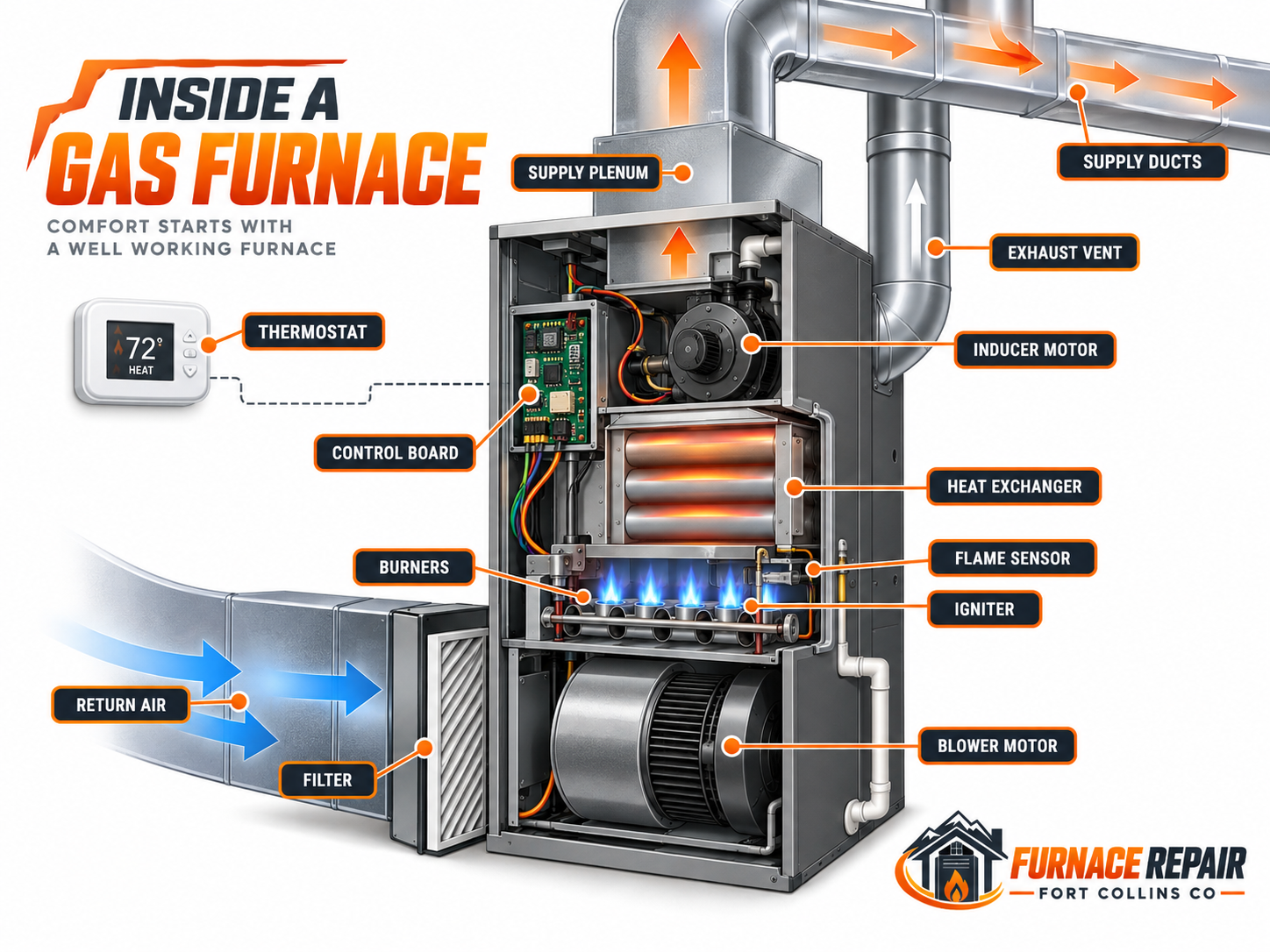
Burners ignite inside a sealed heat exchanger. Combustion gases vent outside; household air passes across the outside of the exchanger and picks up heat before the blower sends it through the ducts. Output temperature is high — supply air commonly arrives noticeably warm to the touch.
Gas furnaces are common throughout Fort Collins and Northern Colorado. Gas furnace repair covers how they are diagnosed and serviced.
Electric furnace operation
Instead of burners, banks of resistance heating elements energize in stages. There is no combustion, no flue and no gas piping, which simplifies some things and makes the electrical side more significant. Output is steady and warm, and every unit of electricity becomes a unit of heat. See electric furnace repair.
How a heat pump transfers heat
A heat pump has an outdoor unit and an indoor coil connected by refrigerant lines. In heating mode, refrigerant absorbs heat from outdoor air — there is usable heat in cold air, just less of it — and a compressor raises its temperature before the indoor coil releases that heat into the airstream.
Because it moves existing heat rather than generating it, a heat pump can deliver more heat energy than the electrical energy it consumes. It also reverses: the same equipment provides cooling in summer, which a furnace cannot do on its own.
One practical consequence is supply air temperature. A heat pump typically delivers air that is warm but cooler than furnace air, so the system runs longer, steadier cycles. Some people describe that as gentler and more even; others notice air from a register feels less hot than they expect.
Energy source differences
A gas furnace runs primarily on natural gas with a modest amount of electricity for the blower, igniter and controls. An electric furnace and a heat pump run entirely on electricity. Which of those is less expensive to operate depends on local utility rates, equipment efficiency, the home's heat loss and how the system is used — it is not a fixed answer, and anyone who quotes one without looking at your bills is guessing.
Cold-weather operation and backup heat
This is where the comparison gets genuinely interesting in a climate like Northern Colorado's. A heat pump's capacity falls as outdoor temperature drops, because there is less ambient heat available to collect. Cold-climate models have improved substantially and continue to produce useful heat at low temperatures, but every heat pump has a point where output no longer keeps up with a home's heat loss.
That is why heat pump systems normally include backup heat — most often electric resistance strips in the air handler. Backup engages when the heat pump alone cannot maintain the setpoint or during defrost, when the system briefly reverses to clear frost from the outdoor coil.
A furnace behaves differently: its output does not decline with outdoor temperature. A correctly sized furnace produces the same heat at minus ten as it does at forty degrees; the house simply calls for it more often.
Dual-fuel systems
A dual-fuel or hybrid system pairs a heat pump with a gas furnace in one setup. Controls run the heat pump in milder conditions and switch to the furnace when outdoor temperature falls below a chosen balance point. The idea is to use whichever heat source suits the conditions, and it is one reason a furnace and a heat pump are not always an either-or choice.
Side-by-side comparison
Neither column is universally better. They are different tools, and the right one depends on the house, the existing ductwork and equipment, local utility rates, and the homeowner's priorities.
| Furnace | Heat Pump | |
|---|---|---|
| Heat source | Creates heat through combustion or resistance elements | Moves existing heat from outdoor air into the home |
| Fuel | Natural gas, propane or electricity depending on type | Electricity only |
| Cooling capability | None on its own; needs a separate AC system | Yes — reverses to cool in summer |
| Cold-weather performance | Output does not drop as outdoor temperature falls | Capacity declines as it gets colder; backup heat supplements |
| Indoor equipment | Furnace cabinet with burners or elements, blower and controls | Air handler or indoor coil with blower and typically backup heat |
| Outdoor equipment | Vent termination only (plus an AC condenser if cooling is installed) | Outdoor unit with compressor, coil and fan |
| Maintenance considerations | Combustion, venting, flame sensing, filters and airflow | Refrigerant circuit, outdoor coil, defrost operation, filters and airflow |
| Typical use | Primary heating, often paired with separate cooling | Year-round heating and cooling, often with backup heat |
Talk through your furnace problem
For service availability, please have your 5-digit ZIP code ready.
Call now for a FREE QUOTE and for service availability. Please have your 5-digit ZIP code ready.
Efficiency concepts, briefly
Furnace efficiency is expressed as AFUE — the share of fuel energy that becomes usable heat over a season. Heat pump heating efficiency uses HSPF, and cooling uses SEER. Because a heat pump moves heat rather than creating it, its effective output can exceed its electrical input, so the numbers are not directly comparable across technologies.
What matters more than any single rating is how the equipment is sized, installed and maintained. A well-installed mid-efficiency system routinely outperforms a poorly installed premium one. Our furnace efficiency guide goes deeper on the furnace side.
Indoor comfort differences
- Furnaces deliver hotter supply air in shorter bursts, which many people perceive as a noticeable blast of warmth
- Heat pumps deliver cooler supply air over longer cycles, which tends to hold temperature steadily but can feel less dramatic at the register
- Longer run times move more air through the filter, which some homeowners find improves consistency room to room
- Both depend completely on duct design and airflow — a comfort complaint is as often a duct problem as an equipment problem
Ducted systems and what they share
Most furnaces and most residential heat pumps in this region are ducted: return grilles bring air back, a blower moves it across a heat source or coil, and supply ducts distribute it. That shared air path means the same things limit both — filter restriction, undersized returns, leaky or poorly routed ducts, closed registers.
If a home has airflow problems today, changing the heat source will not fix them. Weak furnace airflow explains what to look at.
Equipment lifespan considerations
Service life for either depends heavily on installation quality, maintenance and run hours. A heat pump runs year-round for both heating and cooling, so it accumulates operating hours faster than a furnace that rests all summer. Furnaces in well-maintained homes commonly serve a long time before replacement becomes the better economic choice.
How long does a furnace last covers expectations on the furnace side, and repair vs. replacement walks through the decision when an aging system needs significant work.
General Northern Colorado climate considerations
Fort Collins and the surrounding communities see a long heating season with sharp cold snaps and significant day-to-night temperature swings. Those conditions shape the conversation: a furnace's steady output through severe cold is straightforward, while a heat pump's performance depends on the specific model's cold-weather capability and on how its backup heat is configured and controlled.
Homes here also vary widely in age, insulation and duct layout, and that variation often influences comfort more than the choice of heat source. Whatever equipment is installed, the building's heat loss is what it has to overcome.
What we do
We service residential furnaces — gas and electric — in Fort Collins and nearby Northern Colorado communities. We are not positioning ourselves as a heat pump contractor, and this page exists because homeowners researching heating problems reasonably want to understand how the two technologies differ.
If your furnace is the system that needs attention, we are glad to talk it through by phone.